My Life as a Russian Novel by Emmanuel Carrère
Posted: June 3, 2012 Filed under: Books, Documentary, Non-fiction | Tags: Books, Emmanuel Carrère, English, Limonov 1 Comment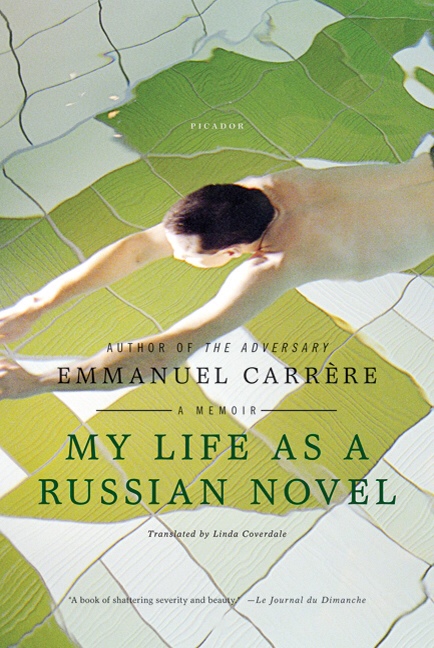 In anticipation of the upcoming translation (I hope) of Carrère's recently published and acclaimed Limonov book, I have picked up his Un Roman Russe to try. Unexpectedly, it was a real page turner, a memoir (unless he lies) depicting a few years of his life – last page finished near 2:30am in the morning, my poor kindle afraid of the bubbling bathtub.
Covers three subjects, predominantly.
Firstly, his vertiginous relationship with his partner Sophie, a true Santa Barbara styled saga of sorts with such unexpected twists and ambushes that one can't but suspects a pinch of fiction spicing up real events. I googled Le Monde story – you would too. Also, the beginning of the book especially, I couldn't but compare it to Limonov's Taming the Tiger in Paris, the book I adore. That Sophie theme, I felt, as key to the book.
Reheated Cabbage by Irvine Welsh
Posted: May 30, 2012 Filed under: Books, Fiction | Tags: Books, English, Irvine Welsh Leave a comment
No buts – Welsh is my fave pulp fiction writer for the past I dunno how many years – guess from late high school or so. This may not be his best book – after all, this reheated cabbage is nothing but a recollection of old and not so old stories published in various mags and multiple author volumes – but still quite nice music to my ears.
Starts off with A Fault on the Line, one of his most cruel short pieces, which I found online ages ago with some help from my friend Mac – a must read in our sick world – published ages ago in Barcelona Review – if you haven’t read it, you just try. Mere 3 or 4 pages long, it’s the jist of cynicism.
Other than that, some stories hit the button more than others. Typical Welsh as I love him – crude, brutal, disgusting at times, a spit in yer face. Plus I definitely loved I Am Miami, a short follow up to 2001 Glue novel, which is the only new story here.
This burd kin fairly gab n it’s aw borin shite aboot crappy modellin jobs, promoting aw sorts ay pony perfumes in malls n the like, but life’s taught ays thit ye huv tae gie fanny a bit ay air time n pretend tae be interested in thair obsessions (them) if yir gaunny be drawin open they beef curtains later oan.
A.D.: New Orleans After the Deluge by Josh Neufeld
Posted: March 11, 2012 Filed under: Books, Comic | Tags: Books, English, Josh Neufeld Leave a comment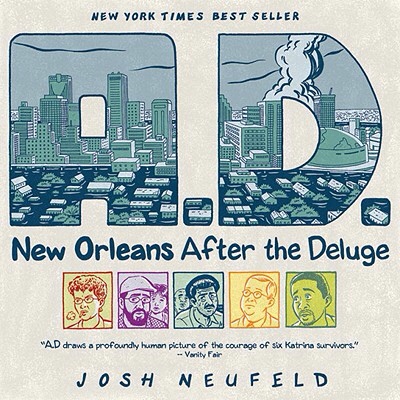
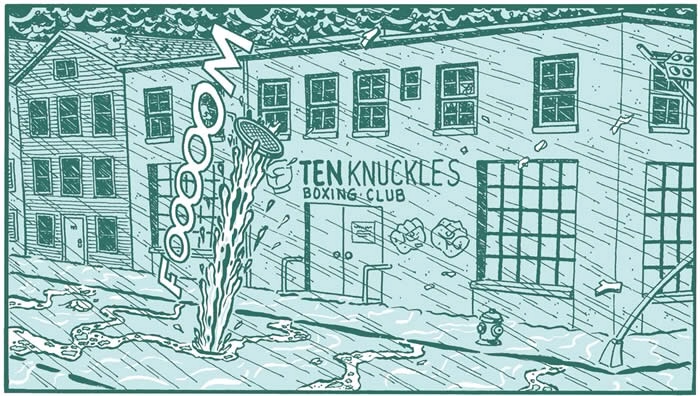
A short non-fiction graphic novel on the US Katrina disaster, A.D.: New Orleans After the Deluge is a one hour long read, tops. Nice work, but has its deficiencies – while brilliantly drawn, it lacks the unique tension of a kind that makes your jaws clutch, like, say, Joe Sacco’s Safe Area Gorazde does.
From pure documentary standpoint, it definitely loses out to Spike Lee’s deeply moving TV classic When the Levees Broke: A Requiem in Four Acts, a meticulous look into Katrina disaster and its aftermath.
Here, the Katrina events are more circumstantial as they relate to the five families Josh picked as his subjects. Some of them are actual Katrina survivors – some are its refugees, evacuated before the wind and the subsequent floods – and the story follows them in a patchy manner, starting from the week preceding the storm and later in the week that followed – plus a glance at how they are coping a couple of years down the road.
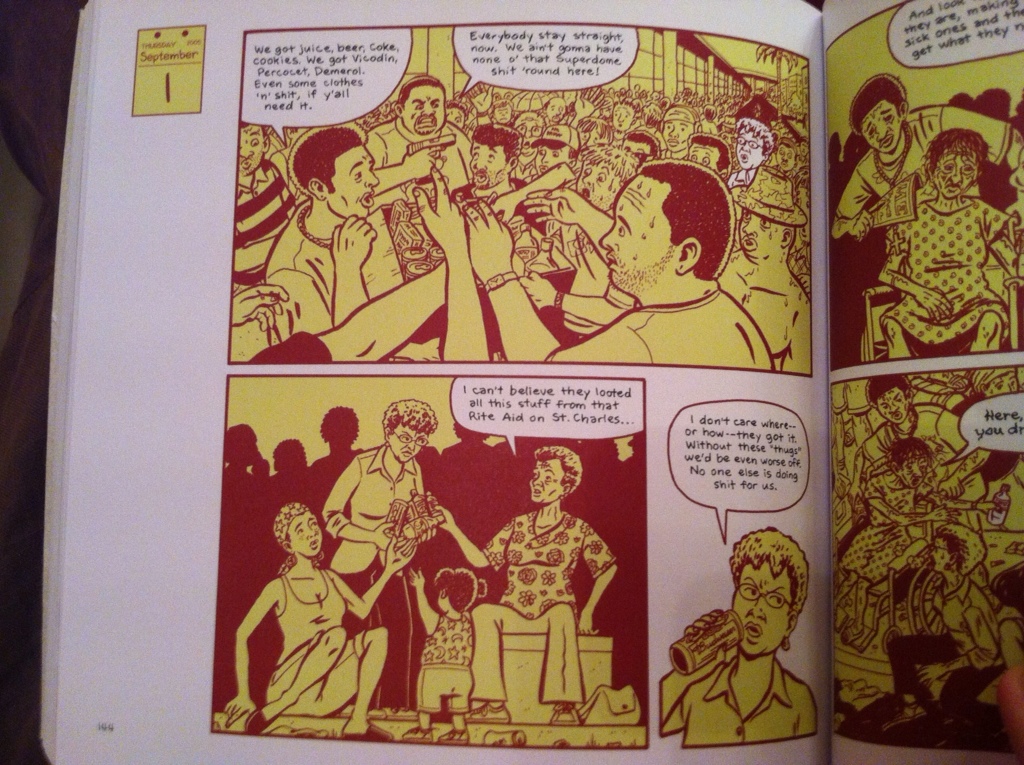
The only moving moment in the book, imho, is the depiction of armed looters and thugs by one of the survivors, Denise, taking refuge in the Convention Center. As opposed to the mainstream image, where non-Caucasian thugs looted and raped the weak and the meek, here they are presented as a people’s militia of sorts, restoring order in the abandoned center and administering food and water rations. Well, each coin has two sides, I guess.

Swallowing the Earth by Osamu Tezuka
Posted: March 10, 2012 Filed under: Books, Comic | Tags: Books, English, Osamu Tezuka Leave a comment
Swallowing the Earth turned out to be the most difficult Tezuka book to lay my hands upon. First, I was waiting for it in Amazon, not falling for pre-order option. Then the book, produced not by Vertical, the usual Tezuka publisher in the US, but rather by DMP, a comic book company I never heard about, went out of stock in a matter of a few days, as quite few copies were published. All you could buy was a lousy used copy at least 5x the cover price. Hm, not for me.
A couple of years later Amazon advertised a kickstarter project by DMP, who were raising money to put out a new edition out – and, not unexpectedly, I subscribed to this funding initiative to get my new copy. Never tried kickstarter before – and, frankly, the idea is nice but I am sure at least half the projects are dead in water after funding. Oddly enough, the guys didn’t lie, and in half a year or so, the book finally came, along with half a dozen of lower quality manga I got hold of as well thanks to my (was it?) $60 funding.
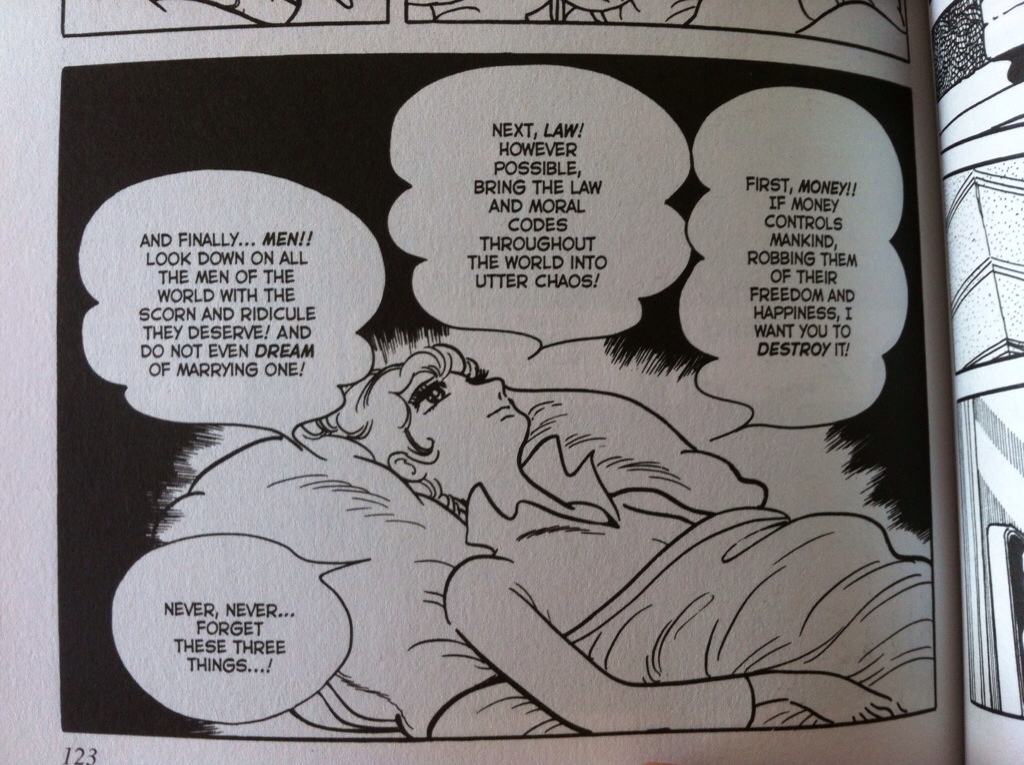
Now, the book is Tezuka’s first serialized graphic novel, written and drawn in 1968, before Ode to Kirihito, MW, Adolf and the rest of his perennial classics. A strange story of women’s revenge against civilization – focused on destruction of money, law and love – and not too much of a happy ending. To my mind, the book lacks clear storyline – it goes away from the main character and back far too easy. Lotsa dead bodies, as usual – sex and violence reign. All in all, too bold and not too well baked for my taste – you can see the master’s touch, but it ain’t a mona-friggin-lisa story-wise. Oh well.
P.S. I realized I missed DMP’s second project for Tezuka’s Barbara. Dang.


El Misterio de la Cripta Embrujada by Eduardo Mendoza
Posted: February 23, 2012 Filed under: Books, Fiction | Tags: Books, Eduardo Mendoza, Spanish 3 Comments
Don’t really know what pushed me into reading Mendoza’s first mad detective comedy novel, written back in 1977 – size, I guess, quite attractive size of bare 200 paginitas “de bolsillo” – and the fact I’ve always liked Mendoza’s style.
In a nutshell, a strange tale about a delusive Barcelona crook confined in a mental institution who gets out on a forced mission to solve a mystery that kept me thinking “why did they pick him?”, composed as a light and funny story. The ending was, eh, mediocre at best – but hey, Mendoza has never been after the result – he is after process.
True as it may be, the book is not on par with Mendoza’s locally (not sure about internationally) acclaimed La Ciudad de Prodigios, Una Comedia Ligera and his latest Premio Planeta winner Riña de Gatos. Madrid 1936 – all of which are perfect period pieces – I hope I will find time to re-read the first two again in the future (for those who don’t know Spanish, no doubt translations are available) – nevertheless, La Cripta is a fast pageturner that eased my overworked mind during three or so evenings, and I now have a serious backlog of a dozen magazines I now subscribe to.
Realized it has two sequels – El Laberinto de las Aceitunas and La Aventura del Tocador de Señoras – should I read them as well? Uh-huh, quizás.
The Big Short: Inside the Doomsday Machine by Michael Lewis
Posted: February 13, 2012 Filed under: Books, Documentary, Non-fiction | Tags: Books, English, Michael Lewis 4 Comments
The Big Short turned out to be quite a wholesome book – it seems, the more I read Lewis, the more I like him – so I guess I have to read more.
To tell you frankly, for a person not too involved with and not too interested in FI markets, I never really took time to analyze what hit the big WS firms back in 2008 – I guess I am still a bit puzzled how the smart guys outsmarted themselves and kept this rotten pile of crap on their balance sheets – I don’t buy into this loan warehousing idea – and blunt bets for the trading units would be, umm, stupid – I know, boys will be boys etc, but still, why not push the crap away to, as Lewis calls him, the sucker, a mystery to me. S&P, AIG and the rest – easy to understand – but MS, ML and the rest of the folks – uh, why?
As in his golden 80s when Lewis spat venom about Salomon Bros, his recent stuff is all about “ibankers, the wrongdoers of the world” – oh, well. #occupymyasshuh
* * *
When a Wall Street firm helped him to get into a trade that seemed perfect in every way, he asked the salesman, “I appreciate this, but I just want to know one thing: How are you going to fuck me?”
* * *
Senior management’s job is to pay people,” he’d say. “If they fuck a hundred guys out of a hundred grand each, that’s ten million more for them. They have four categories: happy, satisfied, dissatisfied, disgusted. If they hit happy, they’ve screwed up: They never want you happy. On the other hand, they don’t want you so disgusted you quit. The sweet spot is somewhere between dissatisfied and disgusted.”
Boomerang: Travels in the new third world by Michael Lewis
Posted: January 29, 2012 Filed under: Books, Documentary, Non-fiction | Tags: Books, English, Michael Lewis 1 Comment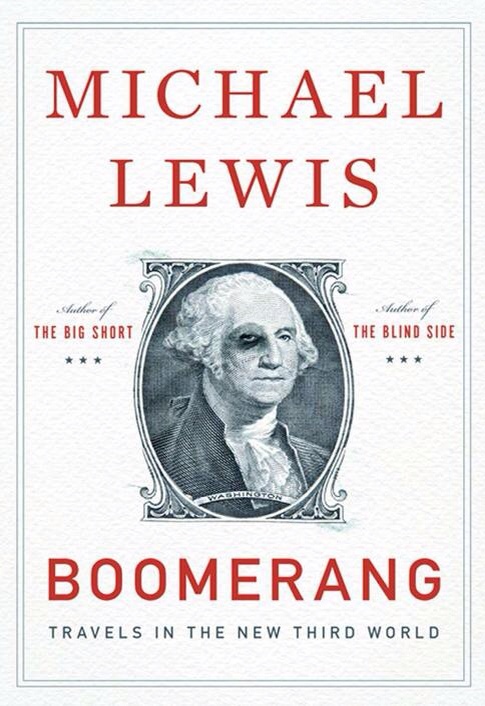
Mike Lewis’s last book isn’t one at all. In fact, it is a collection of five standalone articles published between 2009 and 2011 in the Vanity Fair magazine, disguised as a book and given a new introductory chapter.
Five stories of people that Lewis wants to show as stupid and/or crooked – Icelandic fisherman i-bankers, corrupt Greek public servicemen, Irish real estate developers and politicians who got far too excited to think clearly, anal rule-abiding German-based bond investors, and greedy Californian firefighters – all in one bowl.
A funny read at times – though I guess I should know better than take all Lewis claims for granted – fact of life, the guy loves to exaggerate. The best bits are Iceland and the Greeks, but I will probably steal today’s quote from the German section, huh.
“The Hamburg red-light district had caught Dundes’s eye because the locals made such a big deal of mud wrestling. Naked women fought in a ring of filth while the spectators wore plastic caps, a sort of head condom, to avoid being splattered. “Thus,” wrote Dundes, “the audience can remain clean while enjoying dirt!” Germans longed to be near the shit, but not in it. This, as it turns out, is an excellent description of their role in the current financial crisis.”
PS: BTW that thing, that particular Frankfurt WC, has already been mentioned to me more than once in one quite interesting Russian corporate banking urban legend – did you guess which one? 😉
“The interesting thing, said the German financier, who visited often, is the glass room at the top, from which one looks down over Frankfurt. It is a men’s toilet. Commerzbank executives had taken him there to show him how, in full view of the world below, he could shit on Deutsche Bank.”
Римские откровения Александра Бренера и Варвары Паника
Posted: January 14, 2012 Filed under: Books, Non-fiction, Uncategorized | Tags: Art, Books, Brener, Russian Leave a comment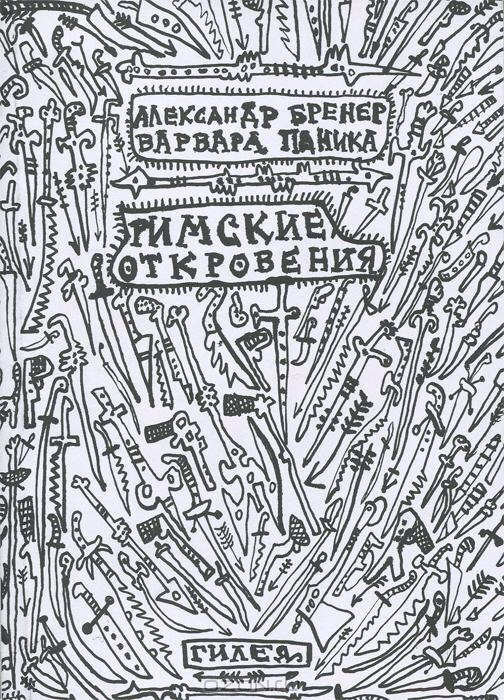
Безобразник и шалун Бренер написал очередную фантасмагорию о своих необычайных похождениях. На этот раз в Риме, но главный герой сего произведения – даже не сам узник голландского правосудия, не подруженция его Варвара Паника (она же Барбара Шурц), не баллончик с зеленой краской, а, простите уж, так вышло, говно.
Новая (старая) концепция: искусство говно, а говно Бренера – искусство.
Сюжет, в общем, идеально описан вот этим фрагментом книги, вызвавшим у меня в момент чтения дикий смех.
11-е откровение: концерт
На следующий день в восемь вечера мы были в кафе-галерее. Уже собралась кое-какая публика. К нам подошёл вчерашний бармен-художник.
— А всё-таки — вы откуда? — спросил он.
— Да мы из Албании, — сказали мы.
— Ха-ха-ха! — рассмеялся художник.
— А воспитывались мы в Китае, — сказали мы. Он продолжал посмеиваться.
Публики еще прибавилось.
— А вы музыканты или художники? — снова спросил бармен.
— Вообще-то мы больше всего любим готовить пасту, — сказали мы. — Вернее, мы её любим есть, — уточнили мы.
Художник опять хихикнул.
— А какую музыку вы будете играть? — спросил он.
— Мы — барабанщики, — сказали мы.
Он отстал. Публика смотрела на нас недоверчиво.
Мы приготовили наш стол. Поставили его на самое видное место. Публика уселась за столики.
Представление началось.
Мы барабанили кулаками по столу. Одновременно снизу мы подталкивали стол коленями, сидя. Сидели за столом и со всех сторон били его — руками и ногами. Одновременно начали раздеваться. Стол ходил ходуном, показывая нашу плоть. Стук был древний, ритмический, сбивающийся с ритма, снова его находящий. Мы сидели за столом и почти разбивали его, но больше всё-таки разбивали кулаки.
И тут мы обосрались. Обосрались себе в руку и тут же размазали дерьмо по столу. И опять колотили его.
Стол был весь испачкан калом. Это был уже не стол. Это был какой-то очень конкретный музыкальный инструмент или просто вещь, из которой мы извлекали звуки. Одновременно мы начали петь. Разные стихи, известные нам с детства. Всякие, разные стихи, которые приходили в голову и согласовывались с ритмом. Было много говна, стихов и ритмических стуков. Был показ гениталий. Было пританцовывание. Всё ходило ходуном.
Публика, кажется, остолбенела. Зрителей набралось много, и всё новые заходили с улицы, вероятно, привлечённые стуком. Кафе-галерея имела большую стеклянную витрину, так что с улицы всё было видно. Люди заходили и начинали сразу снимать происходящее своими мобильными телефонами и камерами. Когда мы это обнаружили, то стали показывать разогнутый палец. Разумеется, он был в дерьме. Всё вокруг уже было в дерьме и воняло.
Какие-то люди стали резко покидать помещение. Наши кулаки были уже основательно отбиты и кровоточили. Мы решили: хватит, кончаем. Очень устали. Всё было довольно интенсивно. Интенсивность — это самое главное в жизни!
Зрители покидали кафе. Сильно пахло говном. Оно было мягким, обильным и легко размазывалось. Вся поверхность так называемого стола была в этой жёлтоватой массе.
Мы еле могли отдышаться от нашего действия. […]
Околоноля Натана Дубовицкого
Posted: January 6, 2012 Filed under: Books, Fiction | Tags: Books, Natan Dubovitsky, Russian Leave a comment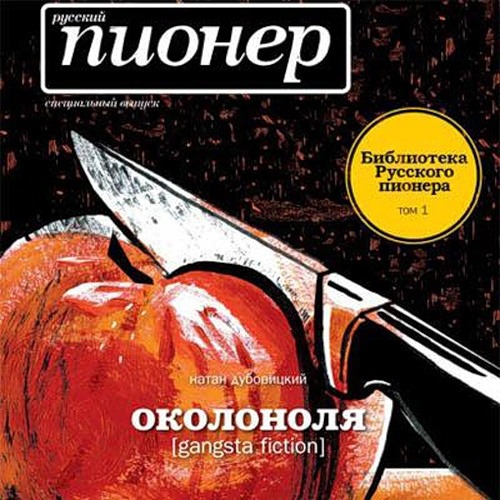
На отдыхе, между бесконечными перерывами на сто тысяч русских и заморских журнальчиков, на которые мы с ИГ подписались через zinio, newsstand, kiosko y más и прочие iPad варианты за последнюю неделю, дочитал урывками, кусками, налетами главный труд великого и могучего идеолога “Нашей” родины. Знаю, торможу и отстаю от всего прогрессивного человечества – ну да ладно.
Если по чесноку – коли правда Асламбек Андарбекович написал сий роман (повесть?) сам, а не при помощи сотни, как их называет Дубовицкий, чернокнижников (а версий, насчет, этого пруд-пруди, целая заводь, я так погляжу), то он, конечно, крутейший пацанчик, и хвала ему как писателю. Циник циника зрит издалека.
Самое ценное в труде этом, конечно, не сюжетная линия вовсе, а внесюжетная чепуха, которая более чем точно отражает нашу родину околонулёвого периода. Двойное-тройное дно, донья, тихий Дон и братки-доны. Понятно, отчего Серебренников их с Прилепиным в дилогию объединил. Занимательный, в общем. М-да.
Ну и в тему нашу, понятно.
— А на айпио вышли уже? — сменил скользкую тему миллиардер. — Я торфяники разместил на полъярда; новосибирские объединённые помойки на чуть больше. В октябре ряжские овраги на айпио вывожу, пару ярдов думаю поднять.
— А что в оврагах-то? — опять зашкворчал ерепенистый фотограф. — За что два ярда-то?
— Китай растёт, Индия растёт, сырьё жрут любое, только давай, и в любых количествах, — пояснил предприниматель. — А в оврагах… Ну… песок, глина… — предприниматель задумался, его собственные слова не убеждали его, он и сам не понимал, почему эта дрянь два миллиарда долларов должна стоить, хотя знал наверное, что стоить будет не меньше; и чтобы не уронить себя в глазах восторженных прихлебателей, бодро завершил. — Глина, вода… Трактор брошенный, помню, на дне — металлолом, значит… Ну и всё такое. Китай растёт, всё в дело идёт, как в китайской кухне.
Санькя Захара Прилепина
Posted: December 26, 2011 Filed under: Books, Fiction | Tags: Books, Limonov, Russian, Zakhar Prilepin 3 Comments
Я, конечно, прокололся, что в свое время пропустил Прилепина. За судьбой Вениаминыча следил пристально, книжки его тюремные читал, даже на его странный и вызывающий улыбку альянс с Каспаровым поглядывал – а Прилепина, так и так, пропустил совсем. Спасибо Платформе и Серебренникову – после “Отморозков” – это сразу попало как #1 item on my reading list.
Пишет супер, коротко, отрывисто, зло. Прямо как нужно. Санька Тишин как отражение потерянных, неустроенных пацанов, неглупых, но и не умных сильно, которым, что страшно, совсем тут нечего терять. Без тени маскировки, история лимоновцев с альтернативным концом (которого, слава богу, не было – пока – чур, его, чур-чуров). И конец, я скажу, как в лучшей книжке Osvaldo Soriano, шальные пули и все такое.
Коротко и о спектакле замечу – не проигрывает книге почти. Часть линий ушла, но ведь спектакль 2 часа, а не 350 страниц. По моему вкусу, наилучший, возможно, образец для современного театра – и художественно, и по контенту.
“– А я живу не в России. Я пытаюсь ее себе вернуть. У меня ее отняли.
– Одни палачи отняли Россию у других палачей. И неизвестно еще, какие из палачей лучше. Нынешние тебя хотя бы в живых оставили.”
PS: Ну и да, нужно собраться прочитать сурковский роман до похода на часть 1 дилогии Серебренникова, да что-то все никак не соберусь – да и не ставят что-то больше.


 nomiresdebajodelacama