The Hive by Charles Burns
Posted: November 25, 2012 Filed under: Books, Comic | Tags: Books, Charles Burns, English, Tintin on drugs 1 Comment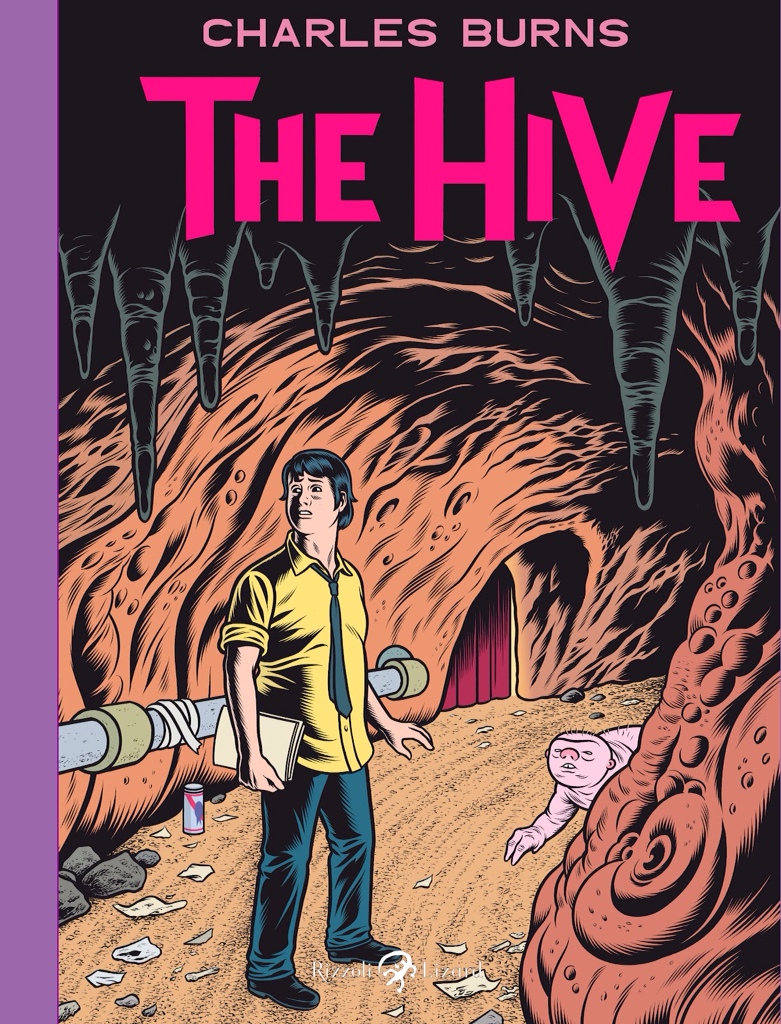
The Hive is a dark and disturbing continuation of X'ed Out, recently published part 2 of Charles Burns' new trilogy definitely inspired by Hergé's Tintin – but with a Naked Lunch twist.
Given it's a very complex multilayer story (part 1 made no sense on its own, part 2 now start to form patterns of sense), I was left with no option but to re-read X'ed Out again – just to remember what it was about. Timelines cross – reality, imagination, hallucinations, present and past, all intersect and collide – and oh boy, now both X'ed Out and The Hive have become a thrilling read.
My problem – by the time part 3, called Sugar Skull, hits the shelves, I will have forgotten X'ed Out and The Hive entirely, and will have to re-read both again. It looks like a marketing scam, I would say, splitting a 300 page graphic novel into 3 thin installments to sell 3 books $20 a piece and not just one for $25. Oh well, I like it so much now that I couldn't care less. Finally, a great follow up to Burns's renowned Black Hole, well overdue.


All You Zombies by Robert Heinlein
Posted: November 5, 2012 Filed under: Books, Fiction | Tags: Books, English, Robert Heinlein, Science Fiction, Zombie 1 Comment
Ages since I read any science fiction stuff. Came upon this short story while wiki'ing Heinlein upon re-watching Starship Troopers recently. Plus, I guess it also popped up on some libertarian wires that flood my facebook feed.
After all, what's $1.25 paid to amazon for a story about a man who realized he is both his own father and his own mother? Well, go figure.
Bambi vs. Godzilla: On the Nature, Purpose, and Practice of the Movie Business by David Mamet
Posted: November 5, 2012 Filed under: Books, Non-fiction | Tags: Books, David Mamet, Filmmaking 3 Comments
Mamet's non-fiction book on the movie business is one big piece of sheer cynicism – and intellectual superiority. Be prepared. A true cinema buff like myself, I was humbled by the vast amount of names and movies I have missed entirely or haven't seen at best. And many things I didn't know – well, I don't know some of them still.
The book is smart, but it ain't an easy ride. When you have every line as a punch line, I tend to miss a few punches. Like some say, your brain is a muscle, and here you are forced to train it.
The most interesting part – the section on Genre. You can read all the Cinema Scope, Sight & Sound, Искусство Кино, etc etc – but this bit is obligatory reading for all the movie zombies like me. You could've skipped War and Piece at school (like I did, miraculously), but you mustn't miss this.
If the shark makes us say “ooh”, it has earned our few dollars. If the filmmaker can make us say “ooh” of a shot of the empty water, give him his private plane.
The observed rule in Hollywood is: “Feel free to treat everyone like scum, for if the desire something from you, they'll just have to put up with it, and should they rise to wealth and power, any past civility shown towards them will either be forgotten or remembered as some aberrant and contemptible display of weakness.”
Why I Left Goldman Sachs by Greg Smith
Posted: November 2, 2012 Filed under: Books, Non-fiction | Tags: Books, English, Goldman Sachs, Greg Smith, Investment Banking Leave a comment
Not a mind blowing book for sure, but maybe a worthwhile, I dunno, bathroom read or something. A few observations, though.
A, the book is 11 chapters long, and the first 10 is all [in high pitched voice] “I love you, Goldman Sachs, I love you”, over and over again. Agree with dealbreaker, sometimes it seemed as if he wanted the firm to turn to him and say “I'm so sorry, Greg, old buddy”, hug him and then elect him partner or CEO or something.
B, most of it is written with an attitude as if he had not outgrown his junior banker excitement – strange to hear it from an overdue VP/ED who worked 11 years in the industry – and especially on GS trading floor, for Christ's sake – would be more acceptable for an analyst or associate to still trumpet all those “wow's” sooo loud and clear. Looks to me GS never promoted the guy for a reason.
C, chapter 11, “the muppets” chapter (the word itself used less than a dozen times), is way too idealistic for my taste. Maybe I am far too cynical (indeed), but why would you run your firm over in the press like that and bury your career along with it? I don't want to, but I kinda buy into Goldman's case that there are two versions to this tale.
Overall, a quick read – not anywhere as good and exciting as The Accidental Investment Banker, but it has its laughs. Roger out.
NurtureShock: New Thinking About Children by Po Bronson and Ashley Merryman
Posted: October 18, 2012 Filed under: Books, Non-fiction | Tags: Ashley Merryman, Books, English, Po Bronson, Psychology Leave a comment
Hard for me to say it, but it's been a while since I tried any psychology book at all, leave alone a child / teen psychology one. All I have to say – a gripping read. First time ever I have a book like this on the beach and don't want to go into the water until the end of the chapter.
Leaves far too many questions open for me, but still – gives extremely valuable advice and sets mind to work on how to bring a child better. Sad I haven't got my hands upon it earlier, say, a year ago or so – actually, it was my wife who found it and put me on course – we would've done a few things differently, I guess.
Set with a purpose of understanding on how to improve parenting experience and get better results in upbringing, the authors do little but summarize in plain “christian” words tons of different research on how to praise a child, stimulate speech development, instill fairness, resolve sibling conflict, teach a child how not to lie etc etc. For me personally, it was a much more useful read than, say, Kindergarten is Too Late – a great book as well, but it gives only concepts that you have to apply in an inexplicable way – but here, some tools as well. Good read.
The Cryptogram by David Mamet
Posted: October 16, 2012 Filed under: Books, Theater / Drama | Tags: Books, David Mamet, English, Theater Leave a comment
Can't say I truly understood what this book was about. I didn't read it as child's coming of age or betrayal related to family breakup, as some reviews claimed.
It seems I am falling out of grace with Mamet – second play in a row that I don't like much. Frankly, Keep Your Pantheon one was funnier and easier to dig.
I reckon I should stop reading his drama and start hitting the theater more often – sad no Mamet available in Moscow though.
Or audio books. Downloaded Speed the Plow for Kindle – will see how it goes.
P.S. Am reading Bambi vs. Godzilla in parallel – also, not an easy read, though it's non-fiction – but it has it's moments, I guess.
Louis Riel: A Comic-Strip Biography by Chester Brown
Posted: October 8, 2012 Filed under: Books, Comic, Documentary | Tags: Books, Chester Brown, English 1 Comment
Imagine a comic book on the story of Stepan Razin or, I dunno, the Decabrist movement. This is what this Louis Riel comic bio is – a story of a renowned Canadian freedom fighter, statesman and politician, hanged by the neck at the end.
Chester Brown has always claimed it to be his masterwork – maybe so indeed, but I prefer his autobio books like Paying For It much more.
Truth be told, Brown must’ve studied quite a few books on Riel – as it shows him with all the weaknesses and controversies. Ah, whatever – not the worst 1.5hr read I’ve had in my life.
Keep Your Pantheon (and School): Two Unrelated Plays by David Mamet
Posted: September 23, 2012 Filed under: Books, Theater / Drama | Tags: Books, David Mamet, English 1 Comment
You have to agree – the title is a smart-ass pun of words, huh?
Keep Your Pantheon is Mamet's 2008 play about a troupe of poor Roman actors struggling to make a buck (well, a few hundred sesterces) and keep not even their pants – their heads on.
Frankly, as much as I like Mamet (by all means, the man is a great playwright), while the book is quite readable (and, god is merciful, short: just 70 pages), it's just not as much fun as, say, Glengarry Glen Ross or Oleanna or even more recent Race.
It is witty and it is about ancient Rome, a very trendy topic recently, but not something I could relate to in full. It probably had something to do with the fact that I view Mamet as a quite contemporary author, and all his attempts at pre-XXth century settings are not exactly my favorites, movies inclusive – take The Winslow Boy, for example – weak.
School is way too short – plus it lacks a meaningful story for me to like it – thought it had a funny quote for me to steal.
B: No, we “won” the war. Though, while not debatable, it is ironic. That the cars we drive. Are made by the nations we obliterated. That's ironic.
Dime Quién Soy by Julia Navarro
Posted: September 22, 2012 Filed under: Books, Fiction | Tags: Books, Junk, Spanish Leave a comment
It's been awhile since I gave up reading a book that I started reading. But this one clearly deserves it.
Bought into a nice sepia filtered old Red Square photo on the cover and a few positive reviews on several blogs and websites – and, poor me, decided to start reading this eleven hundred page monster.
My patience ran out around page 400, at the end of the Moscow bit. While overall I am quite positive on reading historic fiction, like, say some of Mendoza's novels, this one is cheap holiday junk. Reading the Moscow piece, any Russian can't help but notice that this lady has not been to Moscow (or maybe once on a packaged tour), has no clue about minor details that make crap fiction into an intriguing historic read. Clearly, she hasn't heard how much effort Mr. Joyce put into describing a single day.
Uff, while forcing with myself into reading this further, I ended up giving up on reading entirely and back into watching movies, flipping through magazines, procrastinating on facebook, anything, but this junk.
1/5. Or less.
Gone. Moving into something entirely different. Trainspotting prequel is out, Skagboys. Keeping my fingers crossed for the good old grandpa Irvine.
Los Inocentes by Gipi
Posted: August 11, 2012 Filed under: Books, Comic | Tags: Books, Gipi, Spanish 1 Comment
Los Inocentes, a twenty-or-so page-long comic book by Gipi conveniently translated from Italian into Spanish, is a short flashback by a young guy into his own and his friends' wasted youth in the street. How mean hateful people, especially those with power, can provoke children. How children retaliate.
In a sense, the story reminds me of Mathieu Kassovitz's perennial La Haine – or, for those who's seen it, El Bola by Achero Mañas – or, maybe in a more proper sense, Susanne Bier's breathtaking Hævnen.
The art, I'd say, is less prominent visually than that of Exterior Noche, recently read as well, but still quite unique for comic books – as too few are done in paint and not in pencil these days.


 nomiresdebajodelacama